Trademarks


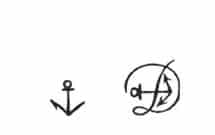
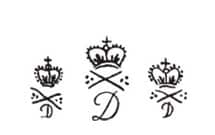
  • Date stamp from 1764 to 1769

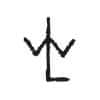
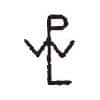
    Rebus for Richard Holdship

    c.1761 - 1769

    Found on transfer-printed wares.

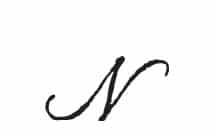
  • Date stamp from 1765 to 1785

    Incised Mark

    c.1765 - 1785


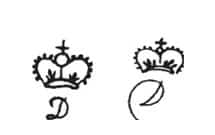
  • Date stamp from 1769 to 1785

    Chelsea Derby Merger

    c.1775 - 1784

    In use during the Chelsea Derby merger; Usually in blue, occasionally in puce.

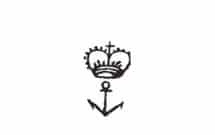
  • Date stamp from 1769 to 1785 in Chelsea during crossover

    Chelsea

    c.1770 - 1784

    In use at Chelsea

  • Date stamp from 1769 to 1785 in Chelsea during crossover

    Chelsea

    c.1775 - 1784

    In use at Chelsea

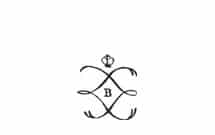
  • Date stamp from 1782 to 1825

    Blue and Puce

    c.1782 - 1825

    After 1820 the previously neatly painted mark became increasingly carelessly drawn.
    Blue and puce were used until 1806, after which red became the standard colour.
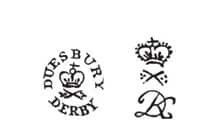
  • Date stamp for 1795

    Rare marks

    c.1790 - 1795


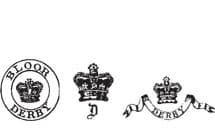
  • Date stamp from 1820 to 1848

    Robert Bloor

    c.1825 - 1848

    Robert Bloor. Printed Gothic-style marks introduced conunteract the carelessly drawn marks; c.1825 - 1848

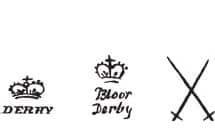
  • Date stamp for 1830

    Bloor figures

    c.1830

    Marks used on Bloor figures. (Right) Pseudo-Meissen mark occasionally seen on late Bloor; c.1830

  • Date stamp from 1830 to 1848

    Pseudo Sévres

    c.1830 - 1848

    Mark used on Sévres copies; c.1830 - 1848

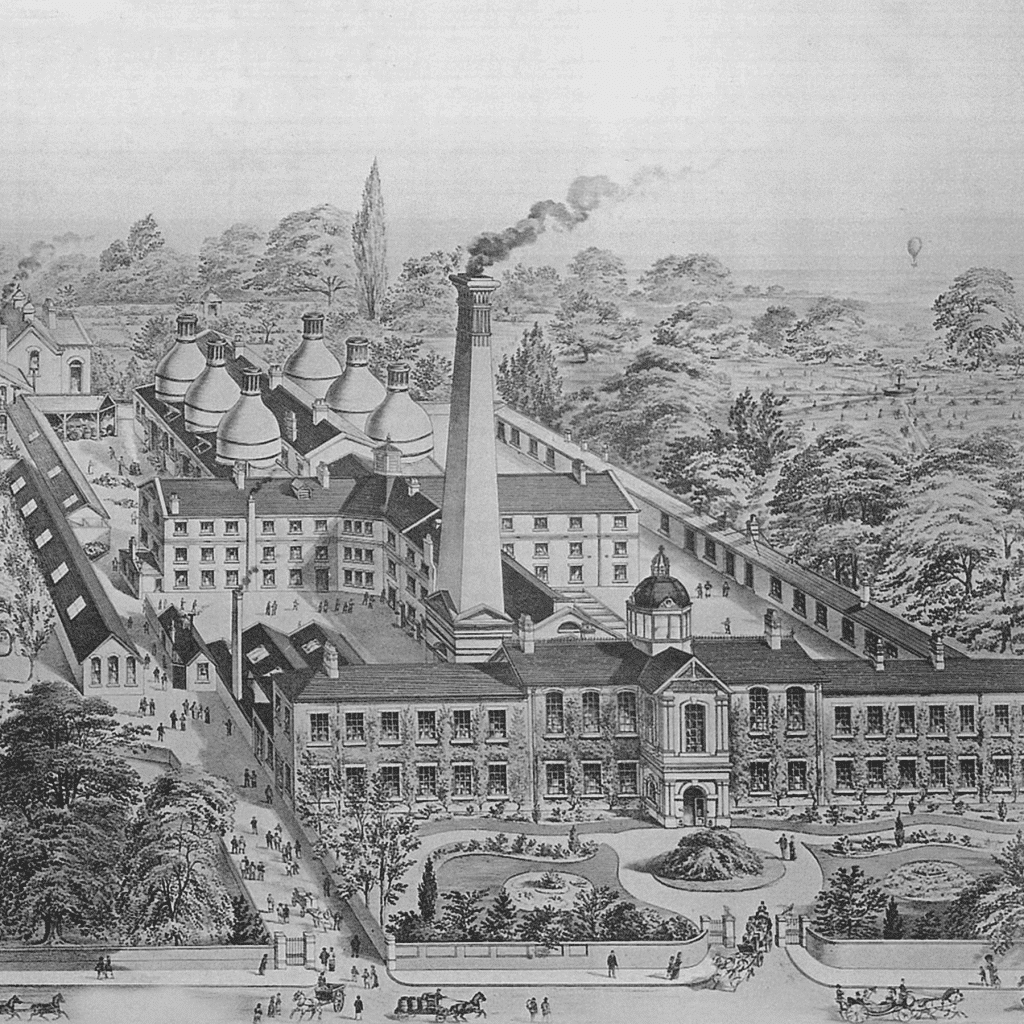
Among the fine painters who worked at King Street were Sampson Hancock, who specialised in flowers, shells and birds; Fredrick Chivers, fruit and flowers; W. Hargreave, birds; J.Ratclifee, George Jessop, F. Schofield and A.Machin, naturalistic flowers and other subjects.

Albert Haddock, one of the finest twentieth-century gilders, and James Rouse senior, who was the only artist to have worked at all three factories, were among the numerous craftsmen who transferred to Osmaston Road after the successful merger with Royal Crown Derby in 1935.

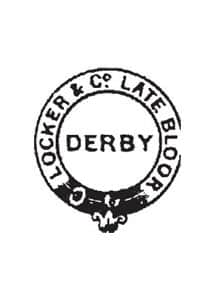
  • Date stamp from 1848 to 1859

    Locker & Co.

    c.1848 - 1859

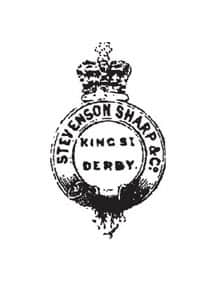
  • Date stamp from 1859 to 1866

    Stephenson Sharp & Co.

    c.1859 - 1861


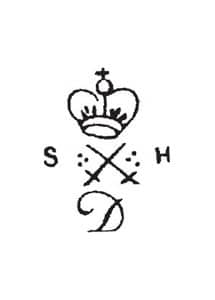
  • Date stamp from 1865 to 1935

    Stevenson and Hancock / Sampson Hancock

    Blue - later nineteenth century
    Red - c.1861 - 1935
    Puce c.1915 - 1935

  •  
  • Modeller stamp for 1916

    William Larcombe

    c.1915 - 1917


  • Modeller stamp for 1917

    Larcombe and Paget

    1917 - 1933


  • Modeller stamp for 1934

    Paget

    c.1933 - 1935


  •  

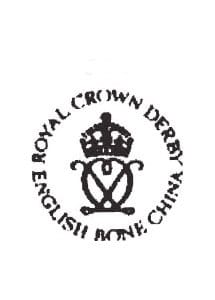
Over the years, many marks and backstamps have been used to identify Royal Crown Derby china. The marks shown here are from the Osmaston Road factory and cover the period from 1877 to the present day. You can discover more in Margaret Sargeant's book "Royal Crown Derby" - it's listed in the "Products" section under "Other Products".

  • Date Stamp from 1890 - 1940

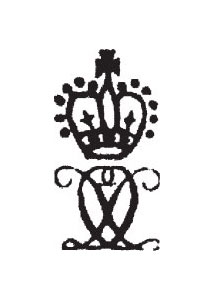
    Derby Crown period

    c.1877 - 1890


  • Date Stamp from 1877 - 1890

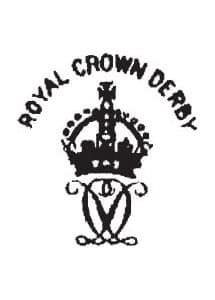
    Royal Crown Derby

    c.1891 - 1921

    The word England in a vertical position to the right hand side.

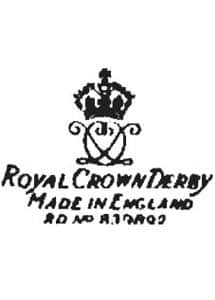
    c.1921 - 1964

    Made in England horizontally beneath stamp

  • Date Stamp from 1940 - 1945

    Wartime mark in dark green

    c.1940 - 1945

    Usually without year code (also used on undecorated utility wares)
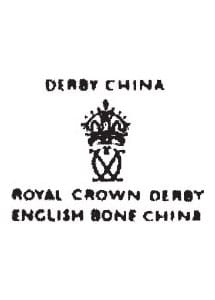
  • Date Stamp from 1964 - 1975

    Royal Crown Derby

    c.1964 - 1975


  • Date stamp from 1976 - Present

    Royal Crown Derby

    c.1976 - Present


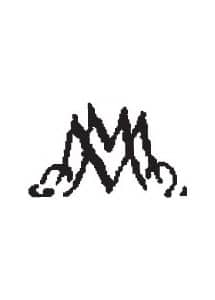
  • 2000 Date Stamp

    Royal Crown Derby

    c.2000

    The special date mark for the year 2000

  •  


  • 1880 mark

    1880

  • 1881 mark

    1881

  • 1882 mark

    1882

  • 1883 mark

    1883

  • 1884 mark

    1884

  • 1885 mark

    1885

  • 1886 mark

    1886

  • 1887 mark

    1887

  • 1888 mark

    1888

  • 1889 mark

    1889

  • 1890 mark

    1890

  • 1891 mark

    1891

  • 1892 mark

    1892

  • 1893 mark

    1893

  • 1894 mark

    1894

  • 1895 mark

    1895

  • 1890 mark

    1896

  • 1897 mark

    1897

  • 1898 mark

    1898

  • 1899 mark

    1899

  • 1900 mark

    1900

  • 1901 mark

    1901

  • 1902 mark

    1902

  • 1903 mark

    1903

  • 1904 mark

    1904

  • 1905 mark

    1905

  • 1906 mark

    1906

  • 1907 mark

    1907

  • 1908 mark

    1908

  • 1909 mark

    1909

  • 1910 mark

    1910

  • 1911 mark

    1911

  • 1912 mark

    1912

  • 1913 mark

    1913

  • 1914 mark

    1914

  • 1915 mark

    1915

  • 1916 mark

    1916

  • 1917 mark

    1917

  • 1918 mark

    1918

  • 1919 mark

    1919

  • 1920 mark

    1920

  • 1921 mark

    1921

  • 1922 mark

    1922

  • 1923 mark

    1923

  • 1924 mark

    1924

  • 1925 mark

    1925

  • 1926 mark

    1926

  • 1927 mark

    1927

  • 1928 mark

    1928

  • 1929 mark

    1929

  • 1930 mark

    1930

  • 1931 mark

    1931

  • 1932 mark

    1932

  • 1933 mark

    1933

  • 1934 mark

    1934

  • 1935 mark

    1935

  • 1936 mark

    1936

  • 1937 mark

    1937

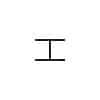
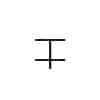
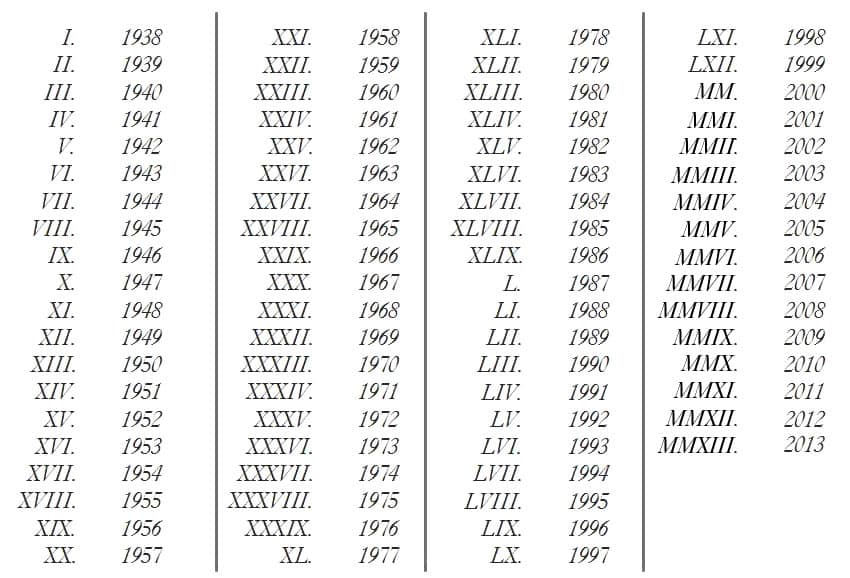
Royal Crown Derby also carries a date mark to identify the year of manufacture. From 1938, roman numerals have been used - the only exception being the 2000, which had a special mark of two interlaced 'M's. 'X' and 'V' have been used twice as date marks - to avoid confusion, 1901 & 1904 are accompanied by 'England', while the roman numerals used for 1942 & 1947 are accompanied by 'Made in England'

Dates


  Loading...